
Every night, 300 million Africans go to bed hungry, yet the amount of food wasted across sub-Saharan Africa could feed 162 million people every year. These numbers reveal a humanitarian crisis that isn’t caused by scarcity; it’s caused by massive inefficiencies in the continent’s supply chains.
In total, 195 million tonnes of food are wasted each year in Africa, worth more than USD 60 billion. That makes food waste one of the continent’s biggest untapped social development and economic opportunities. In 2026, a positive shift is finally underway. In contrast to the pessimistic perspectives of the last decade, we now better understand the issue, know how to fix it, and see companies putting effective ideas in motion.
Addressing food waste where it starts
In wealthier countries like the US, most food loss now occurs in restaurants, grocery stores and homes. In African countries, however, food loss begins in the field. The moment maize, beans, or tomatoes are ready to harvest, farmers start a race against time.
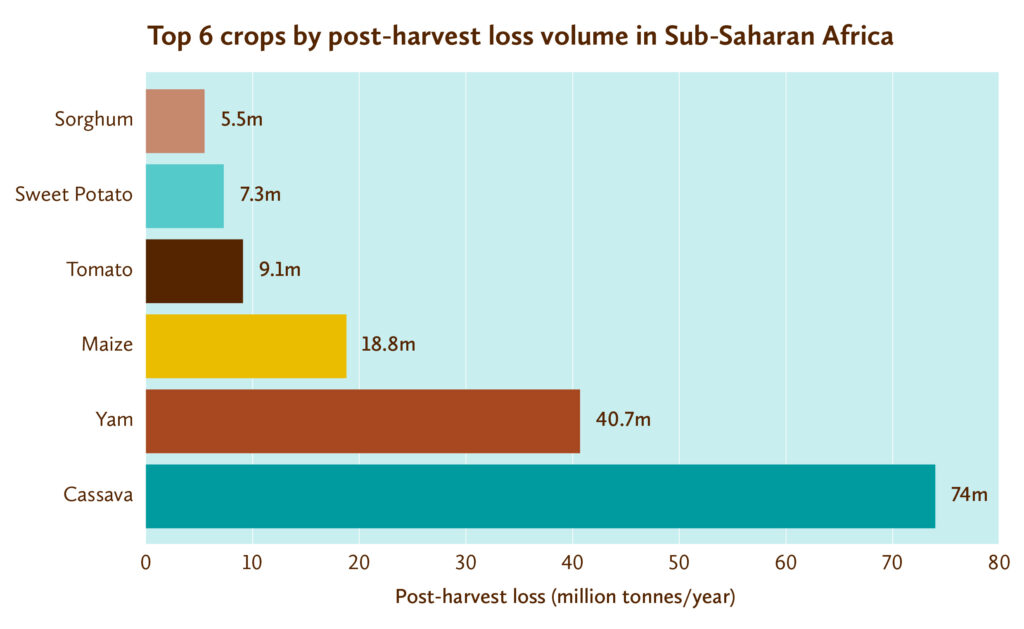
Too often, it’s a losing battle. Take cassava, for example, a starchy root that’s a staple for millions in West and Central Africa. According to data from the FAO and APHLIS (the African Postharvest Losses Information System), 40% of the cassava harvested in African (74 million tonnes) never makes it onto the dinner table. Even if farmers get it out of the field on time, losses stack up throughout the supply chain thanks to poor storage facilities, lack of processing facilities, and inadequate transportation.
Yams see even greater losses of 60% losses (40.7 million tonnes), and products like maize which are easier to store still lose 25% (almost 19 million tonnes annually. In monetary terms, that means USD 7.5 billion in economic value evaporates into thin air.
From nutrition to climate: The implications of reducing food waste
Behind every food waste statistic is a smallholder farmer who invested time, money, and hope into their harvest only to watch 30-60% of their potential earnings disappear. And every lost fruit, vegetable or grain means it never found its way to a hungry person.
By correcting this supply chain issue, many countries could theoretically feed themselves. Nigeria, for instance, loses 24.8 million tonnes of food per year while 12.8% of its population is undernourished. Ethiopia wastes 8.5 million tonnes while 20.6% of Ethiopians are struggling to find just one meal a day. And the Democratic Republic of the Congo loses 6.2 million tonnes while 75.3% of its population goes hungry. Globally, the World Resources Institute calculates that cutting food loss and waste from 24% to 12% globally would close 22% of the food gap needed to feed 10 billion people by 2050.
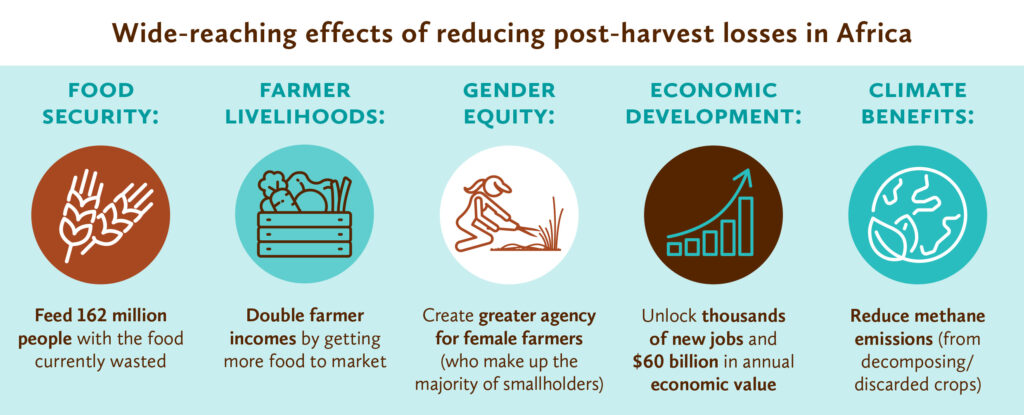
But improving farmer incomes, nutrition and food security are just the most obvious advantages of reducing food waste. Maximising the value of what farmers already grow creates a wider-reaching ripple effect, contributing to broader economic development, gender equity, and crucially, positive climate outcomes.
According to UNEP’s 2024 Food Waste Index Report, global food waste generates 8-10% of all greenhouse gas emissions. When food decomposes in fields or poorly ventilated storage, it produces methane – a greenhouse gas 28 times more potent than carbon dioxide. Despite the direct link between food waste and the climate, only 21 members of the UN have included food loss and waste reduction in their climate action plans.
Companies changing the food waste game
These numbers might sound insurmountable, but the current generation of African entrepreneurs understand the market dynamics and benefits of tackling food waste. Here are a few that are finding ways to reduce post-harvest losses, improve livelihoods, and reduce environmental impact, all while building viable businesses.
Tomato Jos: Transforming fresh tomatoes
In northern Nigeria, where up to 50% of tomatoes rot before reaching consumers, Tomato Jos is rewriting the playbook. The company works directly with smallholder farmers, processing their fresh tomatoes into long-lasting, shelf-stable tomato paste.
Farmers who once lost half their harvest now have a guaranteed buyer and stable income. The company has created hundreds of jobs and Nigerian consumers can finally get locally produced tomato paste, reducing reliance on imports. It’s a triple win: economic development, food security, and sustainable livelihoods.
ColdHubs: Solar-powered storage
ColdHubs has deployed 38 strategically located solar-powered cold storage facilities at outdoor food markets, fresh produce aggregation centres and farm clusters throughout Nigeria. They also offer refrigerated transportation services. The results are remarkable: the company reduced post-harvest losses by 80% and doubled farmers’ incomes.
The model is accessible and affordable, providing space in cold rooms that farmers and traders can rent by the crate – without the need for expensive infrastructure investment. And their pay-as-you-go cold storage model means tomatoes, peppers, and leafy greens stay fresh for weeks instead of days.
Twiga Foods: Digital supply chain disruptor
Kenya’s Twiga Foods is tackling the problem from a different angle: they eliminate the middlemen who slow down the farm-to-market journey. Their mobile platform connects over 17,000 farmers directly with vendors, greatly reducing transportation time and handling. It also ensures higher prices and streamlines payments to farmers.
The company’s peer-reviewed impact data shows losses dropped from 30% to just 4%, an 87% reduction. While the company faced challenges during the global economic downturn, they recently restructured and defined a new growth path to continue working on their mission to reduce waste and improve livelihoods.
Good Nature Agro: Zambia’s legume success
In Zambia, Good Nature Agro (GNA) has built a thriving business around legumes. In contrast to the typical practice growing a monocrop of maize, farmers who work with GNA to grow legumes experience better nutrition, increased soil health (especially nitrogen levels), higher incomes and a guaranteed market offtake.
Under regular circumstances, legumes typically suffer 15-25% post-harvest losses. However, by providing farmers with agronomic training, storage and processing facilities, and a direct market for their crop, GNA’s impact goes beyond reducing post-harvest losses – improving the lives and livelihoods of 22,000 farmers and their families.
A USD 60 billion opportunity
According to a comprehensive analysis by the World Bank, FAO, and African Development Bank, reducing post-harvest losses represents a USD 60+ billion annual market opportunity, grounded in proven business models and real demand.
When it comes to taking advantage of this market opportunity, we’re not starting from scratch. Proven business models already exist. Many entrepreneurs and companies, such as those profiled above, are actively fighting food waste and showing that it’s possible to build profitable businesses while reducing crop losses by 40-80%. And there’s an emerging range of businesses creatively addressing the climate side of food waste, combining climate tech, carbon credits and other innovations.
The next step is to scale. That requires new capital, partnerships, and, in many cases, political will. Nigeria, Kenya, Ethiopia, Tanzania, and Ghana present some of the best opportunities – combining the large volumes of food waste with the most developed investment ecosystems – but the potential extends across the entire continent.
Although impact investors like us are more frequently collaborating with development finance institutions like the IFC, AfDB, and local pension funds, to date, only $1.1 billion has been deployed against a need of $30-50 billion by 2030. This presents a huge funding gap and first-mover advantage for investors willing to enter the fray. Goodwell will continue to invest in this space through our new Growth Capital Fund (GFI), specifically developed to address the financing needs of growing African businesses working in agricultural value chains and related green transformation sectors.
Shaping a different narrative
For too long, the narrative surrounding Africa has been one of scarcity, poverty, and dependence. The post-harvest loss opportunity is just one example of why that story no longer applies, revealing instead a tale of poorly managed supply chains, enough abundance to feed over 160 million people, and local entrepreneurs working to build sustainable businesses that solve local problems.
These businesses are waiting to be scaled with the support of investors who understand their vision. They aren’t looking for handouts; they’re looking for business partners who see the value of solving problems, creating jobs, improving livelihoods, and building inclusive economic ecosystems. When entrepreneurs, investors, and local communities unite to solve the issue of food waste, it will create a cascade of impact that goes far beyond reducing hunger.

