
E-waste is a global problem, with the world on track to produce 82 millions tonnes annually by 2030. West Africa is projected to generate over one million tonnes of e-waste annually in that same timeframe, with Nigeria ranking as the region’s largest e-waste producer. It’s a worrying trend; only a small fraction of e-waste is currently being recycled correctly, leading to severe consequences for public health and the environment, and squandering vital resources needed to further a circular economy and enable the transition to green mobility.
There is a clear and urgent need to formalise and scale up recycling processes in Nigeria and beyond, and with Goodwell’s increased focus on investing with a climate lens and contributing to a green transformation, we’ve been keeping a close watch on opportunities in the waste management sector. In 2025, we proudly announced our investment in Hinckley E-Waste Recycling Ltd through the uMunthu II Fund. Together with Alitheia Capital, we’re supporting the Nigerian-based recycler in constructing two vital battery recycling facilities. During a recent Round Table discussion, Adrian Clews, Hinckley’s Managing Director, shared more details about the company’s vision for a healthier environment, safer jobs, and decent livelihoods.
Responsible battery recycling
Hinckley E-Waste Recycling runs established and effective waste collection and recycling programs, addressing urgent waste management issues in Nigeria. Having successfully raised USD3.5 million in equity, the company has now embarked on an ambitious plan to establish a lithium-ion battery recycling facility and a lead-acid battery recycling facility in Nigeria’s Ogun State. The plants will recycle 25,000 tonnes of used lead-acid batteries and 5,000 tonnes of lithium-ion batteries annually.
Adrian explained that Hinckley’s focus on batteries came from a sense of obligation and urgency. Batteries are one of “the most dangerous waste streams on the planet”. Their responsible disposal and recycling is a growing market – particularly lithium batteries, which are coming into Africa in high volumes, driven by the renewable energy transition. The continent is facing a crossroads in its journey towards sustainability; Hinckley is positioning itself to help local communities safely and responsibly benefit from this evolution across Nigeria – and beyond.
Community focus, community impact
Nigeria’s informal waste sector is already a multimillion-dollar industry. Over 100,000 people (many of whom are women) currently work as collectors, gathering waste while risking exposure to toxic materials like lead, mercury, and cadmium. Informal recyclers purchase this scavenged waste, often furthering health and environmental dangers through unsafe refining and dumping processes. There are better, safer ways to deal with this waste and maintain livelihoods.
During the Round Table, Adrian shared some lessons learned from previous attempts to formalise Nigeria’s approach to waste collection. Prior interventions have tried to eliminate private, informal actors, resulting in massive backlash – and inevitably, failure. As Hinckley grew their business, they “had to tread very carefully,” Adrian explained. After all, they want to support informal workers to operate more safely, not eliminate their jobs.
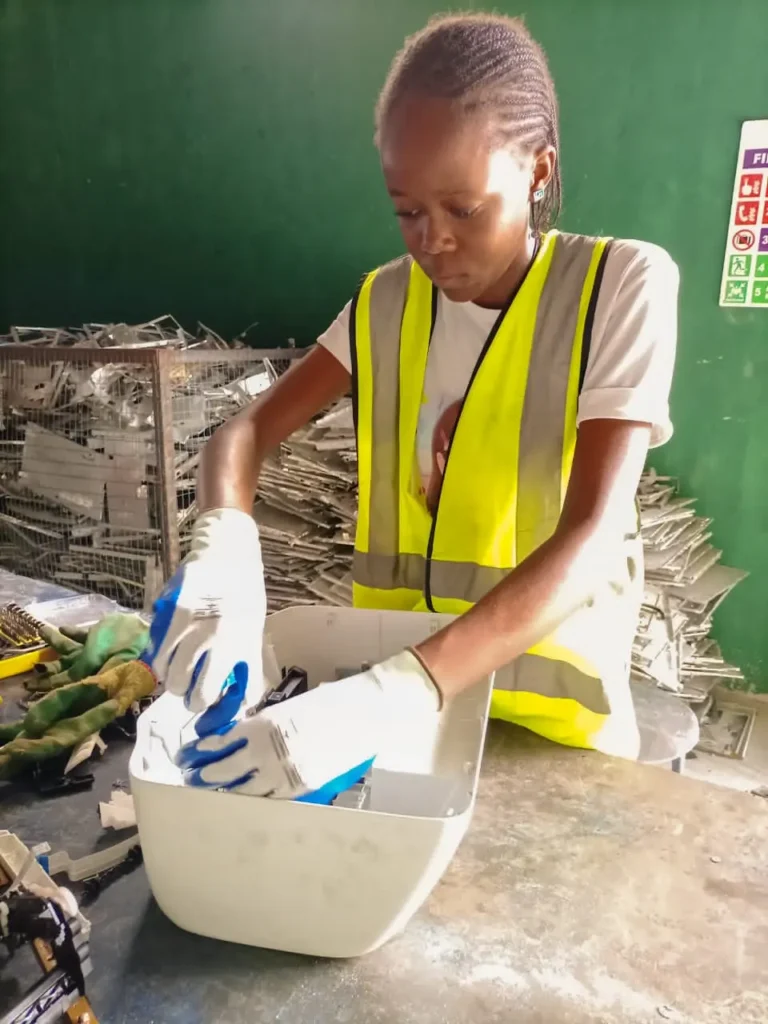
Following engagement and promotion within the surrounding communities to ensure local usage, Hinckley will establish 20 battery collection points across Nigeria. The company will continue to emphasise the inclusion of women in their workforce and community initiatives, while also providing financial incentives and training to informal collectors to improve safety and practices: “We don’t want to just pay them; we also want to formalise them with training and PPE (personal protective equipment), and try to make sure there’s no child labour involved.”
Hinckley aims to create a responsible, inclusive, and community-focused battery recycling operation – one based on “enabling and empowering individuals and organisations, while working with the government to embrace this informal sector and develop policies to protect these informal collectors and the environment,” said Adrian. This approach is a prime example of Goodwell calls “human-centred climate investing” — putting people and their needs at the heart of climate-related financing.
Government engagement and policy development
However, such significant improvements cannot only be the responsibility of private enterprise. Adrian was careful to highlight the need for government enforcement of existing (and future) policies to address e-waste issues. Engaging with the government and informal sector has been a significant challenge, taking seven to eight years of Adrian’s focus to yield real progress. Hinckley worked closely on developing and passing extended producer responsibility into legislation for Nigeria’s e-waste. “That was probably one of our biggest success stories,” Adrian observed. “Prior to that, nothing existed in and around this space. Even now, it’s still heavily informal. … Government engagement, informal engagement, getting everybody together – that was a challenge, but one I think we’ve successfully navigated.”
Hinckley is now a key player in formalising Nigeria’s e-waste recycling market, working closely with regulators and international certification providers. The company has itself been successfully certified to export recycled materials to the EU, further enhancing the viability of their business model and providing a viable way to reduce manufacturer’s reliance on virgin raw materials.
Turning e-waste into a promising future
There are many reasons to be optimistic about the future of e-waste in Nigeria – and the future of Hinckley, who are now well positioned to both address and benefit from e-waste growth by developing local recycling facilities. The company is exploring involvement in other waste streams like printed circuit boards and solar panels. Responsible “urban mining” of such items for reusable materials will make a significant contribution to the circular economy, while also preventing their improper and unsafe disposal.
In the short term, Adrian explained, Hinckley plans to open one of the new battery recycling plants within 1.5 years and achieve a 70% capacity utilisation. Long term aspirations include expanding beyond Nigeria to other African markets, using Hinckley’s Nigerian model as a proof of concept. Goodwell is excited to support Hinckley in turning this ambition into reality, and show that sustainable e-waste recycling can be profitable, scalable, and hugely impactful.

