
Mvuvi Holdings is making a positive impact in the communities where they work by focusing on an affordable, efficient protein: tilapia. Vertical integration not only gives them more control over their value chain, but it also allows them to improve more livelihoods along the way.
As Africa’s population grows, so too does the continent’s hunger crisis. By July 2025, more than one in five people living in Africa were impacted by food insecurity. From famine in the east, to drought in the south, the food and agriculture sector is facing daunting challenges across the continent – but they can be overcome. In response to such obstacles, Africa’s agricultural system needs to develop inclusively, sustainably, and quickly. With the right support, the continent could feed itself – and the world. Part of Goodwell’s mission is investing in businesses creating systemic change throughout entire agricultural value chains; Mvuvi Holdings is one such local company, bringing jobs, food, and lasting impact to southern Africa through innovative aquaculture.
Aligning on aquaculture: fish farming for food security
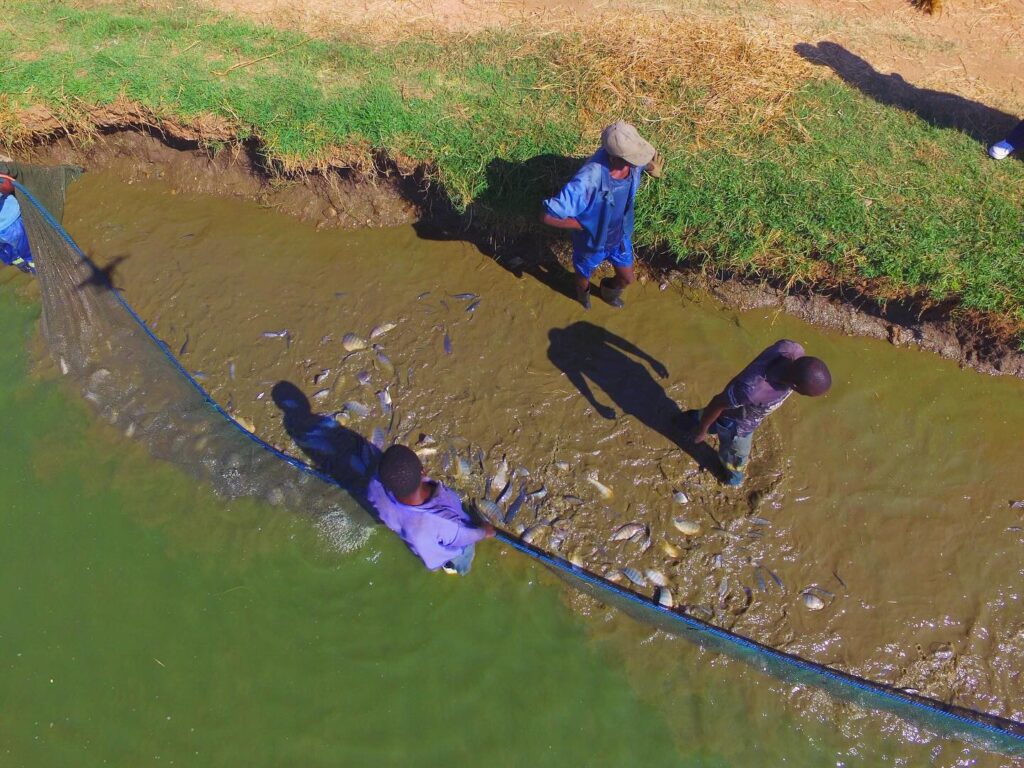
Goodwell first invested in Mvuvi in mid-2020, known at the time as Chicoa Fish Farms. They made an inspiring first impression, strongly aligning with our agricultural investment thesis: Chicoa was delivering affordable, more sustainable protein and providing local livelihoods by farming tilapia in Mozambique. We wanted to support them in building a stable market for their nutritious, low-carbon, cost-effective fish, while improving opportunities for smallholder farmers and food vendors throughout the region.
The company has expanded significantly since our initial investment. In 2024, Chicoa completed a landmark merger with Lake Harvest, forming the vertically integrated tilapia aquaculture group Mvuvi Holdings (“Mvuvi” means “fisherman” in Swahili). Mvuvi now has the largest tilapia production footprint in Africa. The company emphasises local production, leaning into the use of indigenous fish and responsible resource management to improve food security for local communities.
Impact through vertical integration
In a recent Round Table, Mvuvi CEO Gerry McCollum described the inevitability of vertical integration for this type of business: “If you come into an area which is extremely remote and undeveloped … you can’t just start a farm in isolation, because there is no feed supply. There is no net supply. There aren’t reliable distribution services for logistics. By necessity, you have to be vertically integrated. You have to do the input supply side, and the downstream supply side, your distribution and retail. You have to create a whole vertical system – and that creates all sorts of synergies for everybody. The long-term, sustainable goal is to do some horizontal industry building as well, to get more people involved.”
This “horizontal” growth helped pave the way for the merger that birthed Mvuvi Holdings. The company’s latest evolution has the potential to bring significant benefits, from enhanced operational efficiency to risk diversification. The merger allows for scalability and diversification of biological, political, and currency risks across three jurisdictions, as Mvuvi now encompasses three farms: Lake Harvest, Chicoa Fish Farm, and Kariba Harvest. The farms are located in Zimbabwe, Mozambique, and Zambia, respectively, all within the Zambezi Valley. Their proximity facilitates logistics- and idea-sharing between teams. Mvuvi can now specialise their produce, with Lake Harvest focusing on larger fish while the other farms focus on medium-sized fish.
Influencing an industry
Strategic acquisitions like these have also enabled Mvuvi to become a regional player, influencing related legislation and collaborating with smallholders across multiple jurisdictions.
Beyond regional influence, Mvuvi is confident that it has the potential to impact the entire aquaculture industry through its current innovations: “Right now [for example], we are doing offshore breeding, which is so efficient, and it’s really leaning into the natural way of breeding, but it’s so far away from what everyone else is doing at the minute. Once we start rolling that out across southern Africa, you can be sure that these things are going to be replicated by everybody … all the way across the continent, and even globally,” Gerry told our Round Table guests with excitement.
Aquaculture as a sustainable ecosystem
Of course, any type of farming needs to responsibly manage the resources on which it depends, and Mvuvi is fiercely committed to making fish farming more environmentally friendly, starting with their choice of fish: “Tilapia is indigenous to Africa, so it’s really suitable for the environment that we are operating in. It’s an omnivore, so we can include vegetable protein in their diet. It’s a shoaling fish, which means that the farming environment is quite similar to how the fish would live in the wild anyway,” Gerry explained. “It breeds very well, we don’t have to use antibiotics or pharmaceuticals, and it has a good conversion rate. And it sells well – people always love tilapia.”
When it comes to tackling fish waste and potential negative impacts on water sources, Mvuvi is taking a circular approach to feed inputs: “We want to create a feed which converts extremely well. What that means is that we try to have 1.4 kilos of feed which will give us one kilo of fish (the feed conversion ratio). You want that to be as efficient as possible, so there is as little waste going into the water as possible: there’s both an economic and environmental imperative to that.”
Site selection is also important: Mvuvi’s farms are based in oligotrophic waters (lacking in nutrients), which allows for reasonable amounts of fish waste to add nutrients to the ecosystem that are beneficial to the surrounding environment. Their farming practices actually support wild fish populations and maintain ecological balance in the Zambezi River system. Add to this Mvuvi’s pioneering offshore breeding program, and it is clear that sustainable aquaculture can exist responsibly by taking a whole-ecosystem approach.
System change through community building
Building a sustainable business isn’t only about considering the environment. Mvuvi is also examining and addressing the needs of the wider community it which it operates.
During the Round Table, Gerry reflected on how the company’s growth has enabled them to maximise positive impacts for the local communities where they work: “These remote areas are attractive for fish farming as you’re creating jobs in these areas. There are some small schools around [our communities], which are really neglected – particularly in Mozambique. We’re giving the teachers some support, and when a storm came through, we repaired a school roof. We are also helping with some basic water supply issues … and are supporting a village’s small medical centre.”
Embedding themselves within local life and committing to active engagement with the community is improving the quality of life for local residents, and is a living example of a system that benefits both business and community.
Continued path to growth
Mvuvi is dedicated to providing reliable nutrition, livelihoods, and community development while growing their operational footprint. The company is now looking towards a Series B investment round to further stabilise and grow its operations, with expansion possibilities in Malawi, Tanzania, Botswana and Namibia. This vision of inclusive growth requires a consistent influx of capital from like-minded investors.
While contemplating Mvuvi’s future, Gerry observed that to facilitate such growth, “the first thing to do is build your network that shares your vision.” Goodwell is proud to share Mvuvi’s vision, and that our investments enable such impactful companies to manoeuvre and innovate.

